WINDOW ROCK, Ariz. (AP) - Needs across Indian Country include jails, schools, infrastructure and water - on the Navajo Nation, those needs surface on a much larger scale than elsewhere, a U.S. Bureau of Indian Affairs official said Monday.
‘‘These are the needs we need to address,'' Carl Artman, assistant secretary for the BIA told council delegates on the first day of their summer session. ‘‘We want to work with you on a resolution to these issues.''
Among the more pressing needs is education, Artman said. The BIA operates 184 elementary and secondary schools on tribal lands; 66 of those are on the Navajo Nation - seven of which have met annual yearly progress.‘‘We're not failing ourselves,'' Artman said. ‘‘We're failing our students.''
The Navajo Nation has been working on its own set of educational standards that would incorporate culture and tradition. Delegate Ervin Keeswood called on Artman to support the tribe's plans.
Want the whole story? Click here: http://www.mohavedailynews.com/articles/2007/07/17/news/state/state1.txt
Wednesday, July 18, 2007


Trail of Tears in north central Arkansas may be recognized
By: John Anderson
The Trail of Tears, a forced march of American Indians from the homes they had known in eastern states to Indian Territory, present-day Oklahoma, in the early 1800s, is well recorded by historians.
Designation of the Trail of Tears as a National Historic Trail, which was signed into law by former President Ronald Reagan in 1987, led to Americans being educated about the deadly toll of U.S. policies toward American Indians in the days of westward expansion.
But the tale of a journey of about 1,200 American Indians, who took a route on the Trail of Tears crossing the Twin Lakes Area before either lake existed, largely has gone untold.
The Benge route they took in 1838-1839, from northeastern Alabama, through Tennessee, Missouri, Kentucky and Arkansas and to Indian Territory, soon may be designated as part of the Trail of Tears.
Along with the Bell Route that crossed central Arkansas, the designation of the Benge route would add the missing chapters in the saga of the American Indians who were forced to leave their homes.
"We could fully tell the tale of the Cherokee relocation for the first time," said Mark Christ, Community Outreach Coordinator for the Arkansas Historic Preservation Program.
There's more here: http://www.baxterbulletin.com/apps/pbcs.dll/article?AID=/20070717/NEWS01/707170309/1002
The Trail of Tears, a forced march of American Indians from the homes they had known in eastern states to Indian Territory, present-day Oklahoma, in the early 1800s, is well recorded by historians.
Designation of the Trail of Tears as a National Historic Trail, which was signed into law by former President Ronald Reagan in 1987, led to Americans being educated about the deadly toll of U.S. policies toward American Indians in the days of westward expansion.
But the tale of a journey of about 1,200 American Indians, who took a route on the Trail of Tears crossing the Twin Lakes Area before either lake existed, largely has gone untold.
The Benge route they took in 1838-1839, from northeastern Alabama, through Tennessee, Missouri, Kentucky and Arkansas and to Indian Territory, soon may be designated as part of the Trail of Tears.
Along with the Bell Route that crossed central Arkansas, the designation of the Benge route would add the missing chapters in the saga of the American Indians who were forced to leave their homes.
"We could fully tell the tale of the Cherokee relocation for the first time," said Mark Christ, Community Outreach Coordinator for the Arkansas Historic Preservation Program.
There's more here: http://www.baxterbulletin.com/apps/pbcs.dll/article?AID=/20070717/NEWS01/707170309/1002
Leadership finds balance: Women take charge of tribes
By: S.E. Ruckman
Five American Indian tribes in Oklahoma have women as leaders.
WYANDOTTE -- Before becoming the Eastern Shawnee chief, Glenna Wallace served years as the tribe's secretary, eventually replacing her brother who was chief.
Now in public meetings, Wallace is often asked how she should be addressed, although she answers her phone with a lilting, "This is Chief Glenna."
"People want to know, 'What do we call you?' " she said. "Like chief is a man's word."
In a state with 37 federally recognized tribes, five -- or nearly 14 percent -- are led by women.
The Sac & Fox Nation has Chief Kay Rhoads; the Eastern Shawnee recently picked Wallace as chief; Bernadette Huber is ending a two-year term as Iowa Tribe chairwoman; LaRue Parker is the Caddo tribal chairwoman; and the Absentee Shawnee recently inaugurated Jennifer Onzahwah as governor.
Find out more here: http://www.tulsaworld.com/news/article.aspx?articleID=070717_238_A1_hFive65578
Five American Indian tribes in Oklahoma have women as leaders.
WYANDOTTE -- Before becoming the Eastern Shawnee chief, Glenna Wallace served years as the tribe's secretary, eventually replacing her brother who was chief.
Now in public meetings, Wallace is often asked how she should be addressed, although she answers her phone with a lilting, "This is Chief Glenna."
"People want to know, 'What do we call you?' " she said. "Like chief is a man's word."
In a state with 37 federally recognized tribes, five -- or nearly 14 percent -- are led by women.
The Sac & Fox Nation has Chief Kay Rhoads; the Eastern Shawnee recently picked Wallace as chief; Bernadette Huber is ending a two-year term as Iowa Tribe chairwoman; LaRue Parker is the Caddo tribal chairwoman; and the Absentee Shawnee recently inaugurated Jennifer Onzahwah as governor.
Find out more here: http://www.tulsaworld.com/news/article.aspx?articleID=070717_238_A1_hFive65578
Tuesday, July 17, 2007
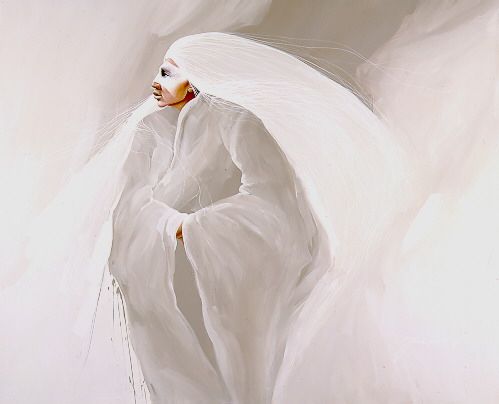
Featured Artist - Rex A. Begaye
The images of a full-blooded Diné artist Rex A. Begaye speak of the univeral connection of Mother Earth, Father Sky and man. Through his paintings, stories that have been passed down for generations by the Elders of many different nations are vividly brought to life. Rex's art celebrates the sacredness and discipline of the Diné culture, lending a contemporary outlook to the ancient traditions. To see his paintings is to span from days of long ago to the edge of tomorrow.
Ceremonies are the way of life for the Diné "In beauty before me, behind me, above me, all around me, I wander." Rex shares the beginning of prayers that "Stays within me and keeps me close to tradition." His harsh upbringing in the heart of Dinehtah (Navajoland) instilled in him the beauty and the richness of his culture. "DINÉ I AM"
Through his paintings, Rex shares with us the simple beauty of living in balance and harmony with Mother Earth. "To paint the way I feel, the meaningful way of life, the teaching of my people, the Native American."
Rex tells a time when, in the midst of the mountains and canyons, he found himself profoundly aware of what Mother Earth has given us. "The teaching of the animals, how to survive in life, to notice, to feel, to hear, to touch. I walked through the canyon and heard the voice of the Anasazi (Ancient Ones), the song, the chants and the prayers whispering along the canyon walls."
"I knelt to sing a song as distant thunder rumbled across the mountains, I grasped a handful of sand, and as it sifted through my fingers back to Mother Earth a sandpainting appeared, healing the wounds of what we mistreat and destroy. Tears slowly traced their way down my face, how I missed the Dinehtah. How difficult our survival in life is.
Check out this website: http://www.rex-a-begaye.com/index2.html
Ceremonies are the way of life for the Diné "In beauty before me, behind me, above me, all around me, I wander." Rex shares the beginning of prayers that "Stays within me and keeps me close to tradition." His harsh upbringing in the heart of Dinehtah (Navajoland) instilled in him the beauty and the richness of his culture. "DINÉ I AM"
Through his paintings, Rex shares with us the simple beauty of living in balance and harmony with Mother Earth. "To paint the way I feel, the meaningful way of life, the teaching of my people, the Native American."
Rex tells a time when, in the midst of the mountains and canyons, he found himself profoundly aware of what Mother Earth has given us. "The teaching of the animals, how to survive in life, to notice, to feel, to hear, to touch. I walked through the canyon and heard the voice of the Anasazi (Ancient Ones), the song, the chants and the prayers whispering along the canyon walls."
"I knelt to sing a song as distant thunder rumbled across the mountains, I grasped a handful of sand, and as it sifted through my fingers back to Mother Earth a sandpainting appeared, healing the wounds of what we mistreat and destroy. Tears slowly traced their way down my face, how I missed the Dinehtah. How difficult our survival in life is.
Check out this website: http://www.rex-a-begaye.com/index2.html
Quotes
"Out of the Indian approach to life there came a great freedom, an intense and absorbing respect for life, enriching faith in a Supreme Power, and principles of truth, honesty, generosity, equity, and brotherhood as a guide to mundane relations." -
Luther Standing Bear - Oglala Sioux
Luther Standing Bear - Oglala Sioux
Lummi to host historic meeting of the nations
by: Redwing Cloud
Proposed 'Treaty of Indigenous Nations' on the agenda
BELLINGHAM, Wash. - The Lummi Indian Nation has volunteered to host a historic meeting July 31 - Aug 2 between U.S. tribes and the First Nations of Canada to discuss the merits of a proposed ''Treaty of Indigenous Nations'' agreement.
''The purpose of the treaty is to create the foundation for an international political and economic alliance for trade relations to address the impacts of climate change, protect cultural properties, and to assert traditional rights to cross international borders,'' said Alan Parker, professor at Evergreen State College and co-chair of the National Congress of American Indians' Special Committee on Indigenous Nations Relationships.
The Special Committee met with the New Zealand Ngati Awa tribes of Aotearoa and First Nations in 2004, 2005 and 2006 to develop the draft treaty.
''The proposed treaty represents three years of consultation and deliberations. We believe that we have distilled the ideas and analysis of some of the best thinkers in the indigenous world in developing the proposal,'' Parker said.
Parker said he feels the primary objective behind the treaty is for indigenous nations to exercise their inherent right to govern themselves, given to them by the Creator and not from a colonial government.
Want to know more? Click here: http://www.indiancountry.com/content.cfm?id=1096415390
Proposed 'Treaty of Indigenous Nations' on the agenda
BELLINGHAM, Wash. - The Lummi Indian Nation has volunteered to host a historic meeting July 31 - Aug 2 between U.S. tribes and the First Nations of Canada to discuss the merits of a proposed ''Treaty of Indigenous Nations'' agreement.
''The purpose of the treaty is to create the foundation for an international political and economic alliance for trade relations to address the impacts of climate change, protect cultural properties, and to assert traditional rights to cross international borders,'' said Alan Parker, professor at Evergreen State College and co-chair of the National Congress of American Indians' Special Committee on Indigenous Nations Relationships.
The Special Committee met with the New Zealand Ngati Awa tribes of Aotearoa and First Nations in 2004, 2005 and 2006 to develop the draft treaty.
''The proposed treaty represents three years of consultation and deliberations. We believe that we have distilled the ideas and analysis of some of the best thinkers in the indigenous world in developing the proposal,'' Parker said.
Parker said he feels the primary objective behind the treaty is for indigenous nations to exercise their inherent right to govern themselves, given to them by the Creator and not from a colonial government.
Want to know more? Click here: http://www.indiancountry.com/content.cfm?id=1096415390
Cochegan Rock, The Mohegans' Giant Boulder
By Carol W. Kimball
Cochegan Rock is in the news again. (The Day, July 2, 2007. “Mohegans get back sacred rock linked to Uncas.) Said to be the largest free-standing boulder in New England, or perhaps the whole country, it has recently been transferred from the Boy Scouts of America's East Hartford-based Connecticut Rivers Council to the Mohegan Tribe.
My father used to talk about Cochegan Rock when I was growing up in Quaker Hill. He used to go there, hiking in from Raymond Hill in Montville, but it was too far for one of our Sunday walks. I heard a lot about the place, but I didn't get to see it until one bright day in June 1986 when my friend Bill Linke, a fine botanist, volunteered to show me the way. Now it is accessible from the Connecticut Turnpike, Interstate 395, from behind the Mobil gas station parking lot, but it is well hidden in the woods. However, there is a wide trail well maintained by the Scouts to guide you there. We crossed the rustic bridge over the placid stream and walked up the wooded hillside.
Cochegan Rock has been one of Montville's claims to fame. In the 1920's a tobacco advertising card used it for their promotion of Connecticut Nugget tobacco, although they spelled it “Cacheecan.” They boasted that it was the largest boulder in the world. On this card the weight was listed as 10,000 tons.
Three centuries ago the rock stood in the middle of Joshua Baker Jr.'s hillside pasture on land granted to his father by a deed signed by Mohegan sachem Owaneco, the son of Uncas, in 1700. According to tradition, Uncas held his council meetings there and used the site for a lookout. It is named for Cauchegan, the Indian who lived in that vicinity when the first English settlers came. One Caleb Cauchegan, probably a descendant, signed a petition a century later in 1749 in the days of Samson Occum.
Read more here: http://www.theday.com/re.aspx?re=3008f6f5-d11d-4571-80de-d3d5a61ab6bd
Cochegan Rock is in the news again. (The Day, July 2, 2007. “Mohegans get back sacred rock linked to Uncas.) Said to be the largest free-standing boulder in New England, or perhaps the whole country, it has recently been transferred from the Boy Scouts of America's East Hartford-based Connecticut Rivers Council to the Mohegan Tribe.
My father used to talk about Cochegan Rock when I was growing up in Quaker Hill. He used to go there, hiking in from Raymond Hill in Montville, but it was too far for one of our Sunday walks. I heard a lot about the place, but I didn't get to see it until one bright day in June 1986 when my friend Bill Linke, a fine botanist, volunteered to show me the way. Now it is accessible from the Connecticut Turnpike, Interstate 395, from behind the Mobil gas station parking lot, but it is well hidden in the woods. However, there is a wide trail well maintained by the Scouts to guide you there. We crossed the rustic bridge over the placid stream and walked up the wooded hillside.
Cochegan Rock has been one of Montville's claims to fame. In the 1920's a tobacco advertising card used it for their promotion of Connecticut Nugget tobacco, although they spelled it “Cacheecan.” They boasted that it was the largest boulder in the world. On this card the weight was listed as 10,000 tons.
Three centuries ago the rock stood in the middle of Joshua Baker Jr.'s hillside pasture on land granted to his father by a deed signed by Mohegan sachem Owaneco, the son of Uncas, in 1700. According to tradition, Uncas held his council meetings there and used the site for a lookout. It is named for Cauchegan, the Indian who lived in that vicinity when the first English settlers came. One Caleb Cauchegan, probably a descendant, signed a petition a century later in 1749 in the days of Samson Occum.
Read more here: http://www.theday.com/re.aspx?re=3008f6f5-d11d-4571-80de-d3d5a61ab6bd
Subscribe to:
Posts (Atom)


