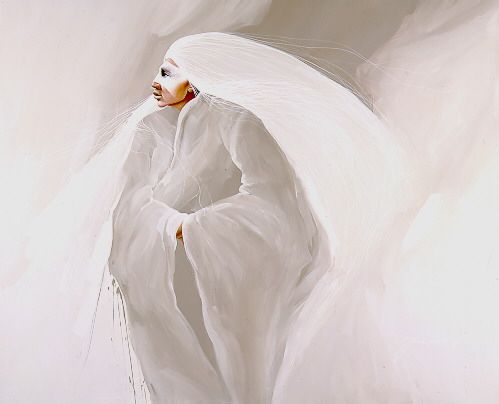
Cheyenne legend...
A long, long time ago the Cheyenne warriors had not learned yet how to use eagle for their war ornaments. One of their men climbed a high mountain; there he lay for five days, crying, without food. Some powerful being, he hoped, would see him and come to him, to teach him something great for his people.
He was glad when he heard a voice say, "Try to be brave, no matter what comes, even if it might kill you. If you remember these words, you will bring great news to your people, and help them."
After a time he heard voices, and seven eagles came down, as if to fly away with him. But he was brave, as he had been told, though he continued to cry and keep his eyes closed. Now the great eagles surrounded him. One said "Look at me. I am powerful, and I have wonderfully strong feathers. I am greater than all other animals and birds in the world."
This powerful eagle showed the man his wings and his tail, and he spread all his feathers as wide as possible. He shows him how to make war headdresses and ornaments out of eagle feathers.
"Your people must use only eagle feathers, and it would be a great help to them in war and bring them victories," eagle said.
Since no loose feathers were about, the seven eagles shook themselves, and plenty of feathers fell to the ground. The Cheyenne picked them up and gratefully took them home to his tribe. On that day, eagle feathers were seen for the first time by the Cheyenne and they knew where they came from.
The man showed his people how to make war ornaments from the eagle feathers, as he had been told. From that day onward, the man became a great warrior in his tribe, and their leader in war parties.
He became so successful his people named him Chief Eagle Feather and he wore his Eagle Feather Warbonnet, as he led the Cheyennes with dignity and pride.
Wednesday, November 7, 2007


Quotes
"I like living in this community, and I like being Choctaw, but that's all there is to it. Just because I don't want to be a white man doesn't mean I want to be some kind of mystical Indian either. Just a real human being." -
Beasley Denson, Secretary/Treasurer of the Choctaw Tribal Council, 1988
Beasley Denson, Secretary/Treasurer of the Choctaw Tribal Council, 1988
Penobscot Indian elder to receive France's highest honor for his service in World War II
By Aimee Dolloff
INDIAN ISLAND, Maine — The attention Monday from media and other Penobscot Nation members was almost more than World War II veteran Charles Shay could handle.
"I’ll be glad when all this is over," he said modestly while waiting in his living room on Indian Island for the arrival of Francois Gauthier, consul general of France in Boston.
Gauthier traveled to Maine on Monday to accompany Shay to Washington, D.C., where today he is to receive the Legion of Honor medal, France’s highest military and civil recognition.
"He’s a courageous soldier," Gauthier said of Shay. "Because he participated in liberating my country, we think we owe him a special recognition."
Founded by Napoleon Bonaparte in 1802, the National Order of the Legion of Honor is the highest civil and military honor in France. It is presented not only for military service, but also for eminent service in other fields such as science or culture, Gauthier explained. Recipients of the honor are named by decree signed by the president of the Republic of France. Shay will be given the title of knight of the Legion of Honor.
"It’s important to me because I’m trying to promote the history of my family, and I’m trying to bring attention to the Native American veterans that served," Shay said.
Read more here: http://bangornews.com/news/t/news.aspx?articleid=156221&zoneid=500
Monday, November 5, 2007
Two New Tribal Exhibitions Open at the
Press release:
The Smithsonian’s National Museum of the American Indian opens two new tribal community exhibitions in the "Our Peoples: Giving Voice to Our Histories" exhibition; the Blackfeet Nation of Browning, Mont., and Chiricahua Apache of Mescalero, N.M. Both exhibitions were developed in collaboration with tribal community curators and National Museum of the American Indian’s curator Emil Her Many Horses (Oglala Lakota). This is the first time that new tribes have been rotated into the permanent galleries since the museum’s opening. The new sections open to the public Friday, Sept. 14.
More than 30 objects will be displayed, including the actual 1855 Treaty of Lame Bull on loan from the National Archives to be displayed for six months and then replaced with a replica for preservation purposes and a porcupine-quilled shirt, the type that might have been worn at the time of the signing of the 1855 Treaty. Featured objects from the museum’s collections include items from a lodge (tipi), such as a parfleche bag made of rawhide and used for storing clothing, a woman’s beaded dress from 1890 and several other historic and contemporary objects.
The Blackfeet exhibition highlights key themes in their history, starting with the revelation of sacred powers, creation stories and their close relationship with the environment. The importance of the medicine lodge (known as the Sun Dance among other tribes of the Plains), the introduction of horses and language preservation are elements that have kept this culture intact. The 1855 Treaty of Lame Bull and Baker’s Massacre in 1870 were pivotal points and show the interaction with the United States government and the resulting tragedies.
Through the contemporary leadership of the Blackfeet Tribal Business Council and efforts of the Blackfeet Community College, the Blackfeet people strive to live in a modern world while
maintaining their culture. The North American Indian Days, held in July, brings families together for the annual celebration of history and culture.
The Chiricahua Apache exhibition shows the forced journey the tribe has made from their homelands in the Southwest to Alabama, Florida., Oklahoma and Mescalero, N.M. where two-thirds of the Chiricahua finally made their home in 1913 along with the Mescalero and Lipan Apache groups. Still after imprisonment for 27 years, the Chiricahua maintained their tribal traditions and values.
Such leaders as Victorio, Mangas Coloradas Geronimo, Cochise and Naiche are highlighted, as well as contemporary leaders like Wendell Chino (Mescalero Apache), who has brought economic stability to the tribe through tourism, a tribal saw mill and fishery and other economic enterprises. Stories of origin and important community ceremonies including the girl’s puberty ceremony are described and shown through clothing and historical images. Objects include a dance shield, a painted hide created by Naiche, child burden baskets made of rawhide, saddles and a water jug made of pitch.
Animated videos and historical and contemporary images present the wide range of life and history for both communities.
In conjunction with the opening of the two new exhibitions, dance groups from each community will perform traditional dances in the Potomac atrium. On Friday, Sept. 14 at 10:30 a.m., the Rawhide Singers from Browning, Mont. will perform northern traditional and grass dances. The dancers are accompanied by singers on a drum. On Saturday, Sept. 15 at noon, the James Kunestsis Apache Crown Dancers from Mescalero, N.M. will perform traditional dances with large headdresses that are painted in the colors of the four directions. The dancers, also known as "Gaan" or "Mountain Spirits," are sent by the Creator to bless and teach the Apache. Both performances are free and open to the public.
Check out the website: http://www.americanindian.si.edu/
Pleasant Point: Tribal program battles violence
By Diana Graettinger
PLEASANT POINT, Maine — Passamaquoddy Peaceful Relations teaches women and girls that they don’t have to be the victims of violence.
The reservation has been offering victim services since 1999, but Passamaquoddy Peaceful Relations is attacking the problem head-on under the leadership of its program coordinator, Nancy Soctomah.
The Passamaquoddy believe there is a precolonial component to domestic violence.
"Prior to European contact," the group’s brochure says, "Native men and women’s roles were based on specific traditional values practiced and honored through individual clans and tribes. Women were honored as pivotal to the survival of the tribe. Although they had separate roles, Native women were considered equal in status to Native men."
Things changed with the arrival of the Europeans. "Associating violence with power occurred in Native communities after the advent of colonization," the brochure says. "Along with this change came a shift in the concepts of women’s roles, in particular defining women and children as property. This imbalance of power created a framework that allows domestic violence to be a common occurrence affecting four million women every year."
Read more here: http://www.nativebiz.com/community/News,op=visit,nid=17001.html
Native Voices at the Autry boosts indigenous playwrights
by: Eva Thomas
LOS ANGELES - Over the last decade, a virtual who's who of American Indian theater artists has worked with Native Voices at the Autry. From Canadian playwright Drew Hayden Taylor, Ojibway, to up-and-coming playwright Larissa Fast Horse, Sicangu Nation, Native playwrights are finding a home to develop works for the stage.
Native Voices at the Autry is a professional Los Angeles-based theater company devoted to developing new scripts by American Indian writers. It is becoming a hot bed for contemporary Native theater. Taking the writer from workshop to staged reading to full Equity productions, Native Voices is committed to creating Native stories.
While teaching at Illinois State University, Native Voices Artistic Director Randy Reinholz, Choctaw, and Native Voices Executive Director Jean Bruce Scott began the task of finding American Indian plays and playwrights.
''I was asked to champion work around Native Americans,'' Reinholz said. ''We found some plays written by Natives and produced a number of staged play readings.'' From 1994 - '96, Reinholz and Scott organized a festival of plays at Illinois State featuring Native works.
Reinholz and Scott continued to develop the plays of Native playwrights; and in 1999, Native Voices at the Autry was born in collaboration with the Gene Autry Museum located in Los Angeles' Griffith Park.
In the mid-'90s, the Autry Museum was putting together an exhibit focusing on images of American Indians and turned to Reinholz and Scott to help create a live theater piece as part of the exhibit. That production was ''Urban Tattoo,'' a one-woman show by Marie Clements, Metis.
Since then, Native Voices has grown and developed into a gathering point for Native theater artists in Los Angeles.
For more information on Native Voices at the Autry, visit www.autrynationalcenter.org/nativevoices.php.
Pawnee elder tells story of surviving Bataan Death March
by: Brian Daffron
CACHE, Okla. - Alexander Mathews carries a high and rare distinction in the Pawnee Tribe.
Considered to be the first Pawnee to see hostile action in World War II the day immediately following Pearl Harbor, he is currently one of only two tribal members for whom the Pawnee Prisoner of War Song can be sung.
Mathews' story, however, is even rarer, as he is a survivor of the Bataan Death March and Hell Ship rides. During this time, Mathews served 3 1/2 years as a POW in both the Philippines and Japan - almost the entire length of WWII. Mathews' story of surviving the sadistic brutality of the Japanese begins with his upbringing in Pawnee, Okla., where he labored long and hard plowing with draft horses, baling hay and doing farm labor.
''I was born May 11, 1919, and I knew what hard work was,'' Mathews said. ''I had worked for different farmers - a dollar a day.''
Decades before, ''Mathews'' became the family last name when interpreters could not understand his father's name when enrolling at the Pawnee Agency in north Oklahoma.
''The interpreter that was interpreting my dad, he could not interpret or explain what the name was,'' he said. ''There was an Army group there. He said, 'Sergeant, what's your name?' He said, 'Mathews.' 'Okay, your name is going to be Mathews.' My dad's name is Buffalo Chief.''
Mathews said his father was afraid of him working and spending all of his money foolishly. His father always told him, ''If you ever feed me, I'll know then that you understood what I was talking about.'' When Mathews began filling the pantries with food as a young man, he earned his father's respect.
There's more here: http://www.indiancountry.com/content.cfm?id=1096416026
Subscribe to:
Posts (Atom)


