Red Ink is a student-run publication at the University of Arizona under the auspices of the American Indian Studies Program. Red Ink has published the works of writers and artists representing Native Nations from across the United States and the North American hemisphere including the Apache, Cherokee, Lakota, Navajo, Havasupai, Hopi, Micmac, Mohican, Maya, Oneida, Seneca, Chemehuevi, Paiute, Walpole Island Ojibway, Choctaw, Creek, Nez Perce, Northern Arapaho, Acoma Pueblo, Tohono O'odham, Yaqui, Menominee, and many others.
Red Ink's primary mission to highlight Native American intellectual and creative expression through the media of poetry, short stories, creative non-fiction, scholarly articles, original artwork and photography, and book, music and film reviews. Red Ink promotes an ongoing discourse with all persons and organizations who are interested in Native American issues and topics. Interdisciplinary in focus, visionary in content, and intergenerational in participation, Red Ink Magazine provides a vital forum for both students and non-students to engage in an open dialogue with other Native American researchers and writers in their respective fields.
Red Ink is designed to promote both scholarly and grassroots publishing by and for Native and non-Native members of--as well as advocates for--indigenous communities. Our goal is to provide a journal that is accessible to non-academics, while also providing a forum for serious scholars. By showcasing a variety of topics as well as literary, scholarly and artistic genres, we hope to appeal to a broad spectrum of people with diverse interests. Red Ink has published several special theme issues, including ones dedicated to Indian gaming, Native children, Native language revitalization and development, and tribal governance and economic development. In addition to scholarly works, Red Ink also publishes an altogether unique mix of poetry, photographs, artwork, short stories, first-person essays, political and social commentaries, cartoons, and reviews of recent books, films and music. And no one could ever forget Red Ink sage Watt Scraper, the 166-year-old Cherokee author of the popular "Unegadihi Speaks."
Check out the website: http://www.redinkmagazine.com/index.html
Friday, September 14, 2007


Court: Navajo Nation owed money for bungled lease
The Interior Department breached its trust to the Navajo Nation and must pay damages for mishandling a coal mining lease, a federal appeals court ruled on Thursday.
In a unanimous decision, the Federal Circuit Court of Appeals said the "undisputed facts" prove Interior breached its fiduciary duties to the largest tribe in the country. Swayed by a lobbyist, the Reagan administration approved a coal mining lease for a less than a "reasonable" royalty rate, the three-judge panel concluded.
That action violated common trust law, as well as a "network" of federal laws and regulations aimed at protecting the tribe's coal resources and keeping the tribe informed about its assets, the court said.
"Accordingly, this court holds that the nation has a cognizable money-mandating claim against the United States for the alleged breaches of trust and that the government breached its trust duties," Judge Arthur J. Gajarsa, a Reagan nominee, wrote in the 39-page ruling.
Want to know more? Click here: http://www.indianz.com/News/2007/004906.asp
Stay on the path, Navajo leader urges UA students
By: Eric Swedlund
In a message emphasizing the resiliency of the Navajo people, tribal President Joe Shirley spoke to about 200 UA students Thursday, urging them to move on with determination to succeed in their studies and become leaders for the tribe.
Shirley spoke eight days after Mia Henderson was fatally stabbed in her dorm room and her roommate, Galareka Harrison, was arrested on suspicion of first-degree murder. Both were 18-year-old freshmen from the Navajo Nation.
"We cannot continue to dwell on it. We have to move on," Shirley said. "This is a great teaching from our elders, from our medicine people. What happened has happened and it is unfortunate. It hurts, it makes us cry, it makes us think about a lot of things. But to the best of our ability, spiritually speaking, we must move on."
Without mentioning either woman by name or specifically talking about the homicide and arrest, Shirley talked about how the Navajo people approach the hurt and sorrow of losing loved ones and how to honor them by moving on with life's work.
There's more here: http://www.azstarnet.com/metro/201177
United Nations moves to adopt indigenous declaration
By: Valerie Taliman
NEW YORK - After three decades of drafts, deliberations and delays, the United Nations General Assembly voted Sept. 13 to adopt the Declaration on the Rights of Indigenous Peoples. The majority, 143 countries, voted in favor. As expected, the only countries opposing the adoption were the United States, Canada, New Zealand and Australia. The main objections of these countries centered on indigenous peoples' control over land and resources, their right to self-determination, and that the declaration might give indigenous peoples veto authority over development on their lands and territories.
Its adoption marks the first time in history that indigenous peoples' collective rights to self-determination and control over their lands and natural resources will formally be recognized by the United Nations.
''The international community is finally recognizing that indigenous peoples have a permanent right to exist as distinct peoples, and that we have a right to be self-governing,'' said Robert Tim Coulter, one of the original authors of the declaration who worked with chiefs from the Iroquois Confederacy to draft the first 10 points in 1976.
''The world is taking a formal stand that indigenous peoples have the right to be free from all forms of discrimination and to maintain our cultures, societies, languages and spiritual practices,'' said Coulter, executive director of the Indian Law Resource Center in Helena, Mont., and Washington, D.C.
Want the whole story? Click here: http://www.indiancountry.com/content.cfm?id=1096415761
Wednesday, September 12, 2007
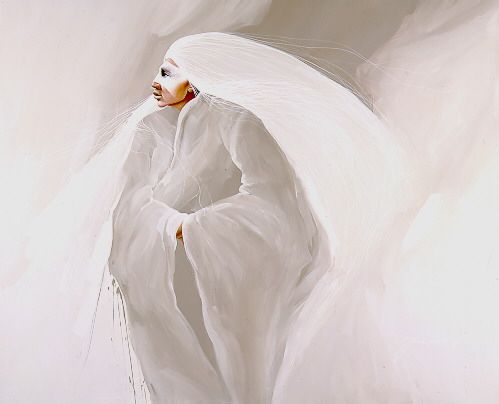
Ghost of the White Deer
A lore of the Chickasaw People of Oklahoma.
A brave, young warrior for the Chickasaw Nation fell in love with the daughter of a chief. The chief did not like the young man, who was called Blue Jay. So the chief invented a price for the bride that he was sure that Blue Jay could not pay.
" Bring me the hide of the White Deer, : said the chief. The Chickasaws believed that animals that were all white were magical. "The price for my daughter is one white deer." Then the chief laughed. The chief knew that an all white deer, an albino, was very rare and would be very hard to find. White deerskin was the best material to use in a wedding dress, and the best white deer skin came from the albino deer.
Blue Jay went to his beloved, whose name was Bright Moon. "I will return with your bride price in one moon, and we will be married. This I promise you." Taking his best bow and his sharpest arrows Blue Jay began to hunt.
Three weeks went by, and Blue Jay was often hungry, lonely, and scratched by briars. Then, one night during a full moon, Blue Jay saw a white deer that seemed to drift through the moonlight. When the deer was very close to where Blue Jay hid, he shot his sharpest arrow. The arrow sank deep into the deers heart. But instead of sinking to his knees to die, the deer began to run. And instead of running away, the deer began to run toward Blue Jay, his red eyes glowing, his horns sharp and menacing.
A month passed and Blue Jay did not return as he had promised Bright Moon. As the months dragged by, the tribe decided that he would never return.
But Bright Moon never took any other young man as a husband, for she had a secret. When the moon was shinning as brightly as her name, Bright Moon would often see the white deer in the smoke of the campfire, running, with an arrow in his heart. She lived hoping the deer would finally fall, and Blue Jay would return.
To this day the white deer is sacred to the Chickasaw People, and the white deerskin is still the favorite material for the wedding dress.
Do you know...
Leslie Marmon Silko, an accomplished Native American contemporary writer, was born in Albuquerque, New Mexico in 1948. She has a mix of Laguna Pueblo, Mexican, and White ancestry. Silko grew up at the Pueblo of Laguna, located in west central New Mexico. She attended a Catholic school in Albuquerque, commuting from Laguna. In 1969 she received a bachelor's degree in English from the University of New Mexico. She later taught creative writing and a course in oral tradition for the English department at the University.
Silko reveals that living in Laguna society as a mixed blood from a prominent family caused her a lot of pain. It meant being different from, and not fully accepted by either the full blooded Native Americans or white people. Silko, despite her pain, was able to overcome the lack of acceptance and identify with the Laguna culture Despite her keen awareness of the equivocal position of mixed-bloods in Laguna society, she considers herself Laguna. As she puts it : "'I am of mixed-breed ancestry, but what I know is Laguna'"(Velie 106).
As a child Silko became familiar with the cultural folklore of the Laguna and Keres people through the stories passed down to her by her grandmother Lilly and her Aunt Susie. These women both had a tremendous effect on Silko, "passing down an entire culture by word of mouth" (Velie 106). While still in college Silko wrote and published a short story "The Man to Send Rain Clouds." For this story she was awarded with the National Endowment for the Humanities Discovery Grant. In 1974 she published Laguna Woman, a book of poetry. In 1977 she wrote her novel Ceremony. The novel received high praise from critics and its readers. She has in fact been called the most accomplished Native American writer of her generation, as well as an "American Indian Literary Master"(Velie npg).
Silko's additional literary works include Storyteller, Almanac of the Dead, and Yellow Woman + the Beauty of Spirit . She has also published several articles dealing with literature as well as other pertinent social issues. Examples of these articles include "In the Combat Zone" and "Race + Racism- Faces Against Freedom."
She is also listed in 100 Native Americans Who Shaped American History.
Want to know more about her? Click here: http://www.ipl.org/div/natam/bin/browse.pl/A75
Featured artist - Tha Tribe
The origin of Tha Tribe is unique in itself. It all started in January 1997 when a bunch of young college students, from different parts of Indian Country, enrolled at Haskell Indian Nations Universtiy. These individuals just sort of clicked together with one basic common interest............Pow-Wow!!!!!!!!!!!!!!!!!!!!
Soon after, they decided just to get together for a jam session to pass the time. After that first song was cracked out, each and every person's face just lit up with excitement for they knew that something extravagant was in the making. It was only a few weeks until these individuals started traveling together, as a group, to pow-wows. During the midst of this beginning, two of the founding members started composing songs left and right for this group.
Another distinctive feature about Tha Tribe is the tribal diversity within the group. Native American Indian Nations are represented within this group from all of the four sacred directions of Indian Country. This allows them to possess capabilities of composing and singing songs in many various Native languages. This key factor is probably what makes this group of young singers so popular. The nations represented by members of Tha Tribe include: Menominee, Oneida, Pueblo, Navajo, Blackfeet, Ojibway, Sioux, Ho-Chunk, Cherokee, Sac&Fox, Cheyenne, Apache, Crow, Potowatomie, and Kickapoo.
Tha Tribe has made many great accomplishments and strive to continue on this path for many years to come. They have completed three professional recordings with Canyon Records and and contributed on three compilations recordings as well with Soar Records entitled Gathering of Nations 1998, 1999, and 2000. The three recordings with Canyon Records are titled T2K, Live from Tornado Alley, and their latest one set for release in Summer 200l called In Action. Just recently, they were awared with a Grammy for the Best Native American Album along with several other groups for their contribution to the compilation recording previously listed entitled Gathering of Nations.
Check out their website: http://www.geocities.com/thatribe2001/
Subscribe to:
Posts (Atom)


