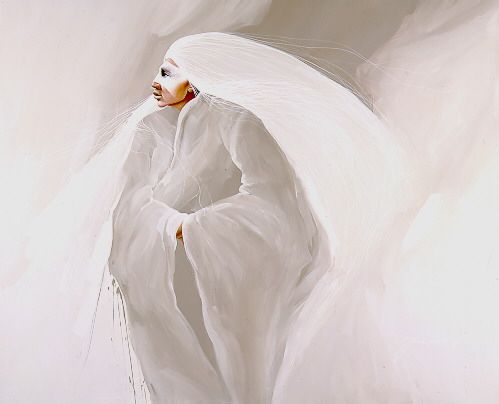
SPOKANE, Wash. - Tinman Gallery recently held an artists' reception for the Native American Group Show April 6, featuring ''three giants of contemporary Native American painting and printmaking.''
Gallery owner Susan Bradley commented, ''This show gathers together a great combination of artists using contemporary art techniques to tell traditional stories.''
The artists are Neil ''Tall Eagle'' Parsons, Blackfeet, now living near Blaine, Wash.; Ramon Murillo, Shoshone/Bannack; and Terrance Guardipee, Blackfeet, of Issaquah, Wash. The work of each varies from the others, thus providing visitors the opportunity to view three very different styles of highly professional Native art.
Parsons was the senior member of the three. He explained the name Tall Eagle was given him by his grandmother. Parsons was one of the original teachers at the Institute of American Indian Arts in Santa Fe, N.M., along with such noted artists as Fritz Scholder, Allan Houser and Charles Loloma.
Full story is here: http://www.indiancountry.com/content.cfm?id=1096415064
Friday, May 25, 2007


Adversity offers benefits for remote Oregon tribe
BURNS, Ore. - The Burns Paiute Tribe is the smallest tribe in Oregon with a reservation on the edge of Burns that measures just 871 acres. But don't let the size fool you - they have a lot going on.
Diane Teeman, the newly appointed cultural specialist, explained the early history.
''After the major era of treaty making, which occurred from the 1840s to the mid-1860s, there were a few treaties being negotiated, but none made it through Congress for ratification. One that didn't make it through was the treaty with the Snakes in 1868 which was signed by the Paiute head men of all of southeastern Oregon with just one exception. Shortly later, a reservation was created by executive order and it was different from other treaties in that no land was deeded and no rights were ceded. It basically stated that the Paiutes would stop fighting and lay down their arms. Because the treaty was never ratified, we're not officially a treaty tribe. It's called a historic tribe.''
The tribe gained land through the Indian Reorganization Act of 1934, which provided funding to purchase land and begin programs. The Paiutes are situated on a number of reservations, including several in Nevada and two others in Oregon. The Burns Paiute Tribe numbers about 350 enrolled members who maintain contacts and have family ties with other Paiute tribes.
Want to know more? Click here: http://www.indiancountry.com/content.cfm?id=1096415055
Thursday, May 24, 2007
Teach your children...
Teach your children that the ground beneath their feet
Is the ashes of our grandfathers.
So that they will respect the land, tell your children
That the earth is
Rich with the lives of our kin.
Teach your children what we have taught our children -
That the earth is our mother.
Whatever befalls the earth, befalls the sons of earth...
This we know: all things are connected
Like the blood which unites one family.
Chief Seattle (seathl)
Duwamish-suquamish
1785-1866
New DVD release presents the contested story of Crazy Horse
RAPID CITY, S.D. - Many people today claim to have some blood tie to Crazy Horse, the revered warrior of the Lakota. People are proud to be connected with the name Crazy Horse, even though there is an ongoing battle over who has control over his intellectual property rights.
Those claiming descent are at odds with each other's version of the story. One side of the family, headed by Floyd Clown, a Minneconjou from the Cheyenne River Reservation who claims to be Crazy Horse's great-grandson, asserts that a DVD series his family put together tells the true story of Crazy Horse. A second family group has debunked the DVD as ''lies.''
''The Authorized Biography of Crazy Horse and His Family,'' part one of a four-part series, consists of three men telling the story of the Lakota and of the Crazy Horse family tree. The 99-minute film continually stresses that the reason for its existence is to tell the truth about the Crazy Horse family.
Anyone who has some knowledge of the Lakota will not acquire any additional historical information by viewing the film and may find some discrepancies.
Click link to read full article. http://www.indiancountry.com/content.cfm?id=1096415058
Quotes
"You sell it to our young men, and give it to them, many times...it rots their guts and causes our men to get very sick, and many of our people have lately died by the effect, and I heartily wish you would do something to prevent your people from daring to sell or give them any of that strong drink." -
King Haglar, Catawba
King Haglar, Catawba
Do you know...
Chief Red Jacket (Sagoyewatha) 1757-1830,
Seneca Chief, Iroquois
Red Jacket was born in 1750 in upper New York State near Conaga, Seneca County, New York. His father was a Cayuga. His mother was a Seneca of the Wolf Clan. At age 10, he was given the name Otetiani or "always ready." At manhood, he was called Sagoyewatha (Sa-Go-Ye-Wat-Ha) which means "he keeps them awake," and he became chief of the Seneca tribe. Red Jacket was a Pine Tree chief who outshone the hereditary chiefs and he dominated tribal and village society.
As a reformed drunkard, Red Jacket advocated social harmony through temperance. The name "Red Jacket" was given to him by the British soldiers who gave him a "red coat," when he fought with the British against the colonies. Red Jacket had a great intellect and was a great orator.
In a discourse about Amerindian tolerance for the differences of others, Ronald Wright, in "Stolen Continents", relates Seneca Chief Red Jacket's response to the efforts of a White preacher to convert his people to Christianity:
"In a scene reminiscent of the debate between Franciscans and Aztec priests nearly 300 hundred years before, the formidable Red Jacket rose to reply. His answer is one of the best ever given to Christianity's claims. Which mentality, he makes one wonder, is the more primitive: that which believes itself to have a patent on truth or that which pleads for cultural diversity, for tolerance, for mutual respect?"
"Brother ... listen to what we say. There was a time when our forefathers owned this great island. Their seats extended from the rising to the setting sun. The Great Spirit had made it for the use of Indians. He had created the buffalo, the deer, and other animals for food. He had made the bear and the beaver. Their skins served us for clothing. He had scattered them over the country, and taught us how to take them. He had caused the earth to produce corn for bread.... If we had some disputes about our hunting ground, they were generally settled without the shedding of much blood. But an evil day came upon us. Your forefathers crossed the great water and landed on this island. Their numbers were small. They found friends and not enemies. They told us they had fled from their own country for fear of wicked men, and had come here to enjoy their religion. They asked for a small seat. We took pity on them, granted their request; and they sat down amongst us. We gave them corn and meat; they gave us poison in return.
Want to know more? Click this link - http://www.danielnpaul.com/ChiefRedJacket.html
'Be rebellious against failure'
''That looks like that girl who played Pocahontas,'' said the coat check woman at the San Francisco Opera House as a striking young woman in a red evening gown passed by.
It was. ''That girl who played Pocahontas'' in the 2005 film ''The New World'' - 17-year-old actress Q'Orianka Kilcher - is now a young woman, with a new film and an articulate vision of the new world she wants to help create.
The film, based on the life of Princess Victoria Kaiulani of Hawaii, will be directed by Marc Forby and is scheduled for international release in late 2008.
Kilcher, who spent part of her childhood in Hawaii, believes she was cast as Kaiulani as much for her activism as her acting.
''They wanted somebody Hawaiian to play the role, but they presented my name to some really big people in Hawaii and they actually heard about my activism and said that there really is no other person that they would want to play the role.''
Kilcher is honored to have been selected for the part. ''Princess Kaiulani was truly an amazing person,'' she said.
Kaiulani was born in 1875 of a Kanaka Maoli mother and Scottish father. Kilcher is Quechua-Huachipaeri on her Peruvian father's side and Swiss-Alaskan on her mother's side. Both women have defended indigenous people in a time of cultural upheaval. Kaiulani, at 17, spoke in Washington on behalf of the Hawaiian nation after it was taken over by U.S. business interests in 1893. Kilcher speaks out in defense of peoples of the Peruvian Amazon, who are threatened by the exploitation of multinational corporations.
Click link to read more. http://www.indiancountry.com/content.cfm?id=1096415060
Subscribe to:
Posts (Atom)


