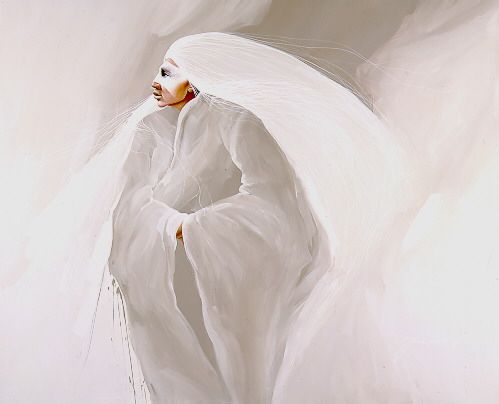
"You have told me that Paradise is very beautiful. Is it more beautiful than the land of the musk ox in summer, when sometimes the mist blows over the little lakes in the early morning...and the loons cry very often? Can I see the caribou roam where I look, and can I feel the wind?" -
Saltatha, Dogrib elder
Saturday, May 26, 2007


Inclusion of Virginia Indians in Jamestown anniversary makes history
RICHMOND, Va. - The eight chiefs of the state-recognized Virginia Indian tribes stood in line near the Capitol steps May 3, awaiting the visit of Queen Elizabeth II of England.
The occasion made history since the event, set to coincide with the 400th anniversary of Jamestown's founding, included Virginia Indians as dignitaries invited to meet the queen as well as the state's General Assembly - and marked the first time Virginia tribes were represented in a Jamestown anniversary.
As Queen Elizabeth II approached the Capitol steps, Chief Ken Adams of the Upper Mattaponi Indian Tribe welcomed her.
''Your majesty, the descendants of the sovereign Virginia Indian nations who greeted your people in 1607 extend a warm welcome to you today,'' Adams said. ''We have the profound privilege of renewing and strengthening our common bonds of history. Just as your people recently greeted us with such honor and dignity, we now return that honor with the Virginia Indian Intertribal Drum and dancers' song of welcome.''
After the welcome, the queen shook hands with the eight chiefs. Chief William Miles of the Pamunkey Indian Tribe gave the queen a broche encased in a clam shell. The broche was a replica of one that Pocahontas wore when she visited England.
Want to read the whole story? Click here: http://www.indiancountry.com/content.cfm?id=1096415084
Senecas vote to charge toll on cars in dispute with state
BUFFALO, N.Y. (AP) - A month after declaring travel on the stretch of New York State Thruway that crosses its land, an ''ongoing act of trespass,'' the Seneca Indian Nation said May 16 it will charge the state a $1 toll for each vehicle traveling the highway.
The action is the latest in a series by Seneca leaders angry at Gov. Eliot Spitzer's plans to collect an estimated $200 million in tax from reservation sales of gasoline, cigarettes and other goods to non-Indian customers.
The tribe plans to send the state a monthly bill for the tolls based on the state Thruway Authority's usage figures. Seneca leaders looked into buying a set of toll booths that are being removed from a Buffalo highway, but were told they were not for sale.
''If New York state would just abide by their word and leave us alone, I think we'd get along much better,'' J.C. Seneca, co-chairman of the nation's Foreign Relations Committee, said May 16.
Click here to read full article: http://www.indiancountry.com/content.cfm?id=1096415093
Law officers remember their dead in Artesia
WASHINGTON - On May 3 in Artesia, N.M., for the 16th year, the BIA conducted a memorial service for tribal, state and federal law enforcement personnel killed in the line of duty on federal Indian lands or in tribal communities.
For only the third year since the initial dedication of the Indian Country Law Enforcement Officers' Memorial, no new name will be added to it, no officer having been identified as fallen in the line of duty. BIA spokesman Nedra Darling said that fact offered at least some ground for good feeling at the solemn occasion. The names of 87 American Indian and non-Indian officers killed in the line of duty since 1852 already inscribe the memorial, and the service this year honored them all.
Carl Artman, newly installed assistant secretary for Indian affairs at the BIA's parent Interior Department, served as guest speaker at the U.S. Indian Police Academy in Artesia. ''It is appropriate that we take time each year to remember the men and women who have died while working to protect Indian country,'' he told an audience of mostly BIA and law enforcement personnel and their families. ''We honor their lives and the sacrifices they and their families have made for the good of all Americans.''
Want to read more? Click here: http://www.indiancountry.com/content.cfm?id=1096415080
Friday, May 25, 2007
Ghost of the White Deer
Chickasaw legend.
A brave, young warrior for the Chickasaw Nation fell in love with the daughter of a chief. The chief did not like the young man, who was called Blue Jay. So the chief invented a price for the bride that he was sure that Blue Jay could not pay.
" Bring me the hide of the White Deer, : said the chief. The Chickasaws believed that animals that were all white were magical. "The price for my daughter is one white deer." Then the chief laughed. The chief knew that an all white deer, an albino, was very rare and would be very hard to find. White deerskin was the best material to use in a wedding dress, and the best white deer skin came from the albino deer.
Blue Jay went to his beloved, whose name was Bright Moon. "I will return with your bride price in one moon, and we will be married. This I promise you." Taking his best bow and his sharpest arrows Blue Jay began to hunt.
Three weeks went by, and Blue Jay was often hungry, lonely, and scratched by briars. Then, one night during a full moon, Blue Jay saw a white deer that seemed to drift through the moonlight. When the deer was very close to where Blue Jay hid, he shot his sharpest arrow. The arrow sank deep into the deers heart. But instead of sinking to his knees to die, the deer began to run. And instead of running away, the deer began to run toward Blue Jay, his red eyes glowing, his horns sharp and menacing.
A month passed and Blue Jay did not return as he had promised Bright Moon. As the months dragged by, the tribe decided that he would never return.
But Bright Moon never took any other young man as a husband, for she had a secret. When the moon was shinning as brightly as her name, Bright Moon would often see the white deer in the smoke of the campfire, running, with an arrow in his heart. She lived hoping the deer would finally fall, and Blue Jay would return.
To this day the white deer is sacred to the Chickasaw People, and the white deerskin is still the favorite material for the wedding dress.
Do you know...
Pushmataha (1764 - 24 December 1824)
The "Indian General", was a chief of the Native American tribe of the Choctaws, regarded by historians as the "greatest of all Choctaw chiefs". Pushmataha was highly regarded among both Native Americans and Europeans for his skill and cunning in both war and diplomacy. Rejecting the offers of alliance and reconquest proffered by Tecumseh, Pushmataha led the Choctaws to fight on the side of the United States in the War of 1812. He negotiated several treaties with the United States. In 1824, he traveled to Washington to petition the Federal Government against further cessions of Choctaw land; he there met with John C. Calhoun and Lafayette, and his portrait was painted by Charles Bird King. He died shortly thereafter and was buried with full military honors in the Congressional Cemetery in Washington, D.C..
The exact meaning of Pushmataha's name is unknown, though all agree that it contains the connotations of ending. Many possible entymologies have been suggested:
Apushamatahahubi: "a messenger of death; literally one whose rifle, tomahawk, or bow is alike fatal in war or hunting."
Apushim-alhtaha, "the sapling is ready, or finished, for him."
Pushmataha, "the warrior's seat is finished."
Pushmataha, "He has won all the honors of his race."
Apushimataha, "No more in the bag."
In addition, some sources report that he was given the early warrior-name of Eagle.
Want to know more? Click here: http://en.wikipedia.org/wiki/Pushmataha
Quotes
"When an Indian is killed it is a great loss, which leaves a gap in our people and a sorrow in our heart." -
Chiksika, Shawnee, elder
brother of Tecumseh
Chiksika, Shawnee, elder
brother of Tecumseh
Subscribe to:
Posts (Atom)


